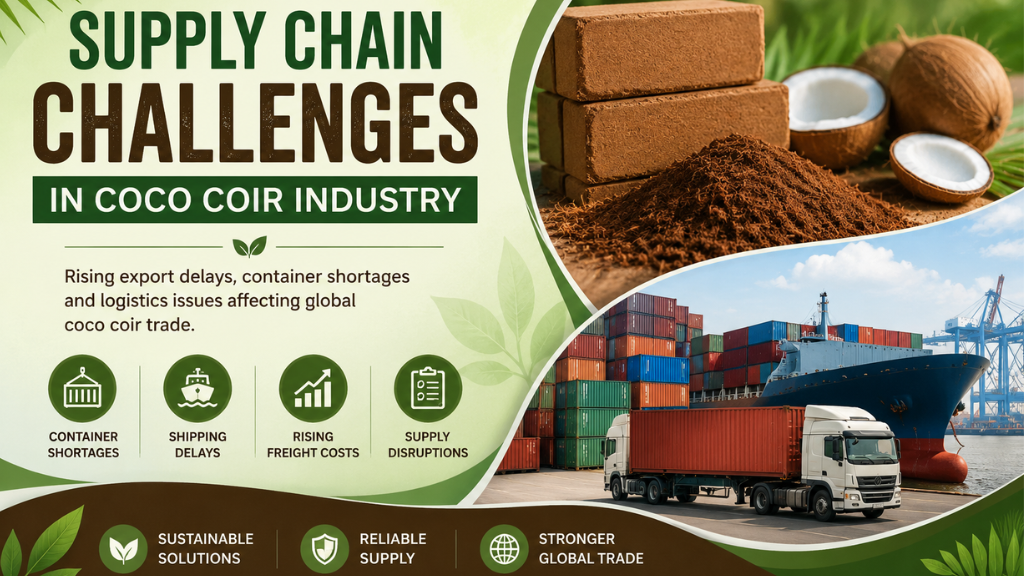
“Rising Export Delays and Container Shortages Challenge Global Cocopeat Supply”
Global demand for sustainable growing media is increasing rapidly, making the coco coir supply chain essential for timely delivery and stable sourcing. However, logistics disruptions and rising cocopeat supply chain challenges are creating concerns for international buyers. Importers, greenhouse operators, and hydroponic farms across the US, Europe, and the Middle East now prioritize exporters with reliable supply systems and consistent global shipping capabilities.
This article says about what are the challenges in Coco Coir Industry and how the Cocopeat Exporters overcome these cocopeat logistics issues to maintain stable global trade and supply.
Understanding Coco Coir Supply Chain?
The coco coir supply chain refers to the complete process involved in sourcing, processing, packaging, transporting, and exporting coco coir products from manufacturing facilities to international buyers.
The supply chain typically includes:
- Coconut husk collection from farms
- Raw material transportation
- Fiber extraction and processing
- Washing, drying, and buffering
- Compression into blocks or grow bags
- Packaging and palletizing
- Inland transportation to ports
- Container loading and international shipping
In simple terms, the supply chain moves coco coir products from coconut-growing regions to hydroponic farms, greenhouses, retailers, and distributors worldwide.
Because cocopeat products are heavily export-oriented, the efficiency of the coco coir supply chain directly affects product availability, delivery timelines, and import costs. Any disruption at sourcing, manufacturing, or shipping stages can create large-scale operational problems for global buyers.
Major Supply Chain Challenges
The global coir sector currently faces several operational and logistics-related disruptions. These cocopeat supply chain challenges are affecting exporters and importers across major international markets.
i) Container Shortages
One of the biggest concerns in recent years has been the ongoing cocopeat container shortage affecting global exports. Limited container availability at ports has increased waiting periods for exporters and delayed shipment schedules.
Exporters often struggle to secure containers during peak agricultural seasons, resulting in postponed dispatches and reduced supply consistency for overseas buyers.
ii) Port Congestion
Heavy congestion at international ports has significantly contributed to coco coir shipping problems. Delays in vessel arrivals, customs clearance backlogs, and limited unloading capacity increase transit times across global trade routes.
For importers, these delays affect warehouse planning, cultivation schedules, and retail distribution commitments.
iii) Rising Fuel and Freight Costs
Global fuel fluctuations continue to drive cocopeat freight cost increase across major shipping routes. Ocean freight charges, inland transportation expenses, and warehousing costs have all risen substantially.
As logistics expenses increase, exporters are forced to adjust pricing structures, impacting the overall landed cost for international buyers.
iv) Raw Material Delays
Seasonal weather changes and fluctuations in coconut availability can affect husk collection and processing schedules. These sourcing interruptions create additional cocopeat logistics issues, especially when global demand rises unexpectedly.
Manufacturers without integrated sourcing systems often face production slowdowns and inconsistent inventory availability.
v) Labor Shortages
Labor shortages in manufacturing units, ports, and logistics operations continue to contribute to coco coir export delays. Delays in processing, packaging, container loading, and customs documentation can extend shipment lead times significantly.
vi) Documentation and Compliance Delays
International trade regulations, phytosanitary certifications, and customs compliance requirements also create operational slowdown. Improper documentation can increase coco coir export risks, particularly for time-sensitive agricultural shipments.
Impact of Supply Chain Issues on Global Buyers
The impact of supply chain disruptions extends far beyond shipping delays. These challenges directly affect cultivation operations, inventory management, and commercial commitments for buyers across various global regions.
United States
Hydroponic farms and greenhouse growers in the US rely heavily on imported cocopeat products for commercial cultivation. Frequent coco coir export delays can disrupt crop production cycles and delay seasonal planting schedules.
Additionally, increasing freight rates and the ongoing cocopeat freight cost increase are significantly affecting procurement budgets for agricultural distributors.
Europe
European buyers prioritize sustainable growing media for organic farming and greenhouse cultivation. However, port congestion and cocopeat container shortage issues often create inventory shortages for retailers and commercial growers.
Importers in Europe are increasingly seeking exporters with stronger logistics planning and long-term shipping coordination to minimize supply instability.
Middle East
The Middle East depends heavily on greenhouse cultivation due to climatic conditions. Reliable cocopeat availability is essential for maintaining controlled farming environments.
Any coco coir delivery delays can impact agricultural productivity, greenhouse scheduling, and large-scale farming operations. This has increased demand for exporters capable of maintaining stable year-round supply chains.
How These Challenges Affect the Trade
Global supply disruptions are reshaping procurement strategies within the coir industry. Rising logistics expenses, limited container availability, and shipping uncertainties continue to increase operational costs for exporters and buyers alike.
The ongoing cocopeat freight cost increase has increased the landed cost of cocopeat products across international markets. Importers are now paying higher freight charges, storage fees, and port handling expenses.
At the same time, persistent cocopeat logistics issues are increasing lead times across major export routes. Delayed container bookings, customs bottlenecks, and shipping congestion often extend delivery schedules by several weeks.
These operational disruptions also contribute to frequent coco coir delivery delays, making inventory planning increasingly difficult for distributors and commercial growers.
Because of coco coir shipping problems, international buyers are shifting their focus from low-cost sourcing toward long-term supplier reliability and logistics stability.
How Reliable Cocopeat Exporters Are Overcoming These Challenges
Experienced exporters are adopting advanced operational strategies to maintain supply consistency despite ongoing disruptions in the global coco coir supply chain.
Better Logistics Planning
Reliable exporters proactively coordinate shipping schedules, freight bookings, and customs documentation to reduce shipment interruptions. Early container reservations help minimize the impact of coco coir shipping problems during peak seasons.
Inventory Management
Leading manufacturers maintain buffer inventory and planned production schedules to reduce supply fluctuations caused by raw material shortages and export congestion.
Multi-Port Shipping Strategies
Using multiple export ports helps reduce dependency on a single logistics route. This strategy minimizes shipment delays and improves export flexibility during port congestion.
Integrated Sourcing Networks
Exporters with vertically integrated sourcing systems are better equipped to handle coco coir export risks associated with raw material shortages and seasonal supply disruptions.
Reliable Cocopeat Exporters strengthen supply reliability through extensive sourcing networks, in-house manufacturing capabilities, and streamlined export operations. Their large-scale production infrastructure and global distribution experience help international buyers maintain consistent supply even during challenging market conditions.
Tips for Importers to Avoid Supply Chain Risks
International buyers can reduce procurement disruptions by adopting proactive sourcing strategies.
| Tips for Importers | Purpose |
|---|---|
| Choose Certified Exporters | Ensures quality, reliability, and transparent logistics |
| Verify Supply Chain Stability | Helps manage cocopeat supply chain challenges effectively |
| Plan Bulk Orders Early | Reduces risks from cocopeat container shortage and freight delays |
| Confirm Logistics Capability | Minimizes coco coir export risks through better shipping coordination |
| Maintain Safety Inventory | Prevents disruption caused by coco coir delivery delays |
How Chithu Group Overcomes Supply Chain Challenges
At Chithu Group, supply chain stability is built through integrated sourcing, large-scale production infrastructure, and efficient export coordination. With extensive experience in the coir industry, we maintain consistent raw material procurement, streamlined manufacturing processes, and planned inventory management to support uninterrupted global supply.
By adopting proactive logistics planning, multi-port export strategies, and strict quality control systems, Chithu Group effectively minimizes coco coir export delays, manages cocopeat logistics issues, and ensures timely deliveries for international buyers. Our strong global distribution network helps greenhouse operators, hydroponic farms, and distributors maintain reliable product availability even during fluctuating market conditions.
Conclusion
Growing global demand and ongoing logistics disruptions continue to intensify cocopeat supply chain challenges across international markets. A resilient coco coir supply chain is now essential for reliable sourcing and timely delivery. Chithu Group help global buyers reduce coco coir export risks through stable production, integrated sourcing, and dependable export operations.
Keep your supply chain moving with Chithu Group’s trusted cocopeat export network.
FAQs
1) What causes cocopeat delivery delays?
The most common reasons include port congestion, container shortages, customs clearance delays, labor shortages, and shipping schedule disruptions. These factors often contribute to coco coir delivery delays in international markets.
2) How to avoid cocopeat supply chain issues?
Importers can reduce risks by working with experienced exporters, planning orders early, and choosing suppliers with stable sourcing networks to minimize cocopeat logistics issues.
3) Which country has stable cocopeat supply?
India remains one of the most reliable global suppliers because of its large coconut cultivation base, established export infrastructure, and advanced processing facilities supporting the global coco coir supply chain.
4) How to choose a reliable cocopeat exporter?
Buyers should evaluate production capacity, export history, certifications, sourcing networks, logistics management, and delivery consistency before selecting an exporter.
5) Why are freight costs increasing for cocopeat exports?
Global fuel price fluctuations, container shortages, shipping congestion, and rising transportation expenses are major contributors to the ongoing cocopeat freight cost increase.